
Compare Laurens County Property Values
Different value labels answer different questions. A Laurens County tax bill starts with a January 1 valuation. Georgia law assesses taxable property at 40 percent of fair market value. Exemptions and preferential programs then adjust the amount that millage actually applies to. A deed or transfer record tells a separate story. It captures what a buyer and seller agreed rather than what the tax roll carries. Checking both gives a fuller picture of a parcel in Laurens County.
| Value type | Meaning | Record source |
|---|---|---|
| Fair market value | County estimate of the property's full value for the tax process | Assessor parcel record and digest |
| Assessed value | Forty percent of fair market value under the stated Georgia level | Assessor roll |
| Net taxable value | Tax base after applicable exemptions or programs | Tax record and bill |
| Last sale or consideration | Evidence from a specific transfer, which may not be an open-market sale | Recorded deed or transfer filing |
A quick illustration helps. Multiply a fair market estimate by 40 percent to reach the assessed value before exemptions. The recorded document controls, though. A gift, estate transfer, foreclosure deed, tax-sale deed, or quitclaim may carry consideration that never reflects a normal sale price.
Georgia's Laurens Assessment Level
Fair market value and assessed value are two different things in Laurens County, and the county's own materials draw the line clearly. The Laurens property-tax explanation lays out the distinction. It also names January 1 as the valuation date. That single date anchors every figure. So a renovation finished in March, a summer sale, or a late-year market swing will not move the number recorded for that tax year, because the valuation snapshot was already fixed.
Two offices divide the work. The Board of Tax Assessors sets the value on each parcel in the property records, while the Tax Commissioner bills, collects, and distributes the tax itself. Keep those roles straight when you call. Valuation questions about the tax roll go to the assessors at 478-272-6443, and anything about a tax bill goes to the commissioner at 478-272-6994. The official source page shows the county's full valuation framework and this office split at a glance.
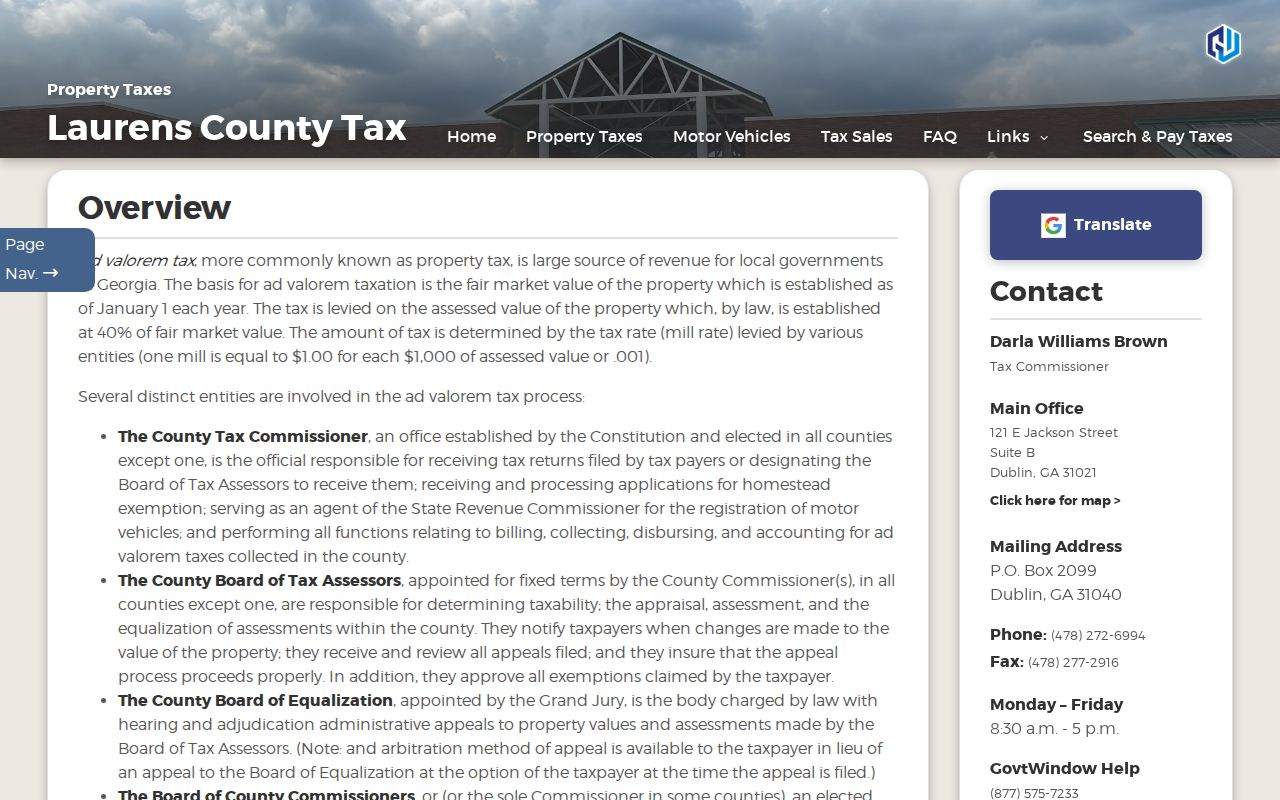
The capture is a rules source, not a parcel appraisal or live value card.
Look Up Laurens Property Value
The official Laurens qPublic landing page starts every parcel-value search. Field labels and card order can vary between versions. Search with the options the current form presents, and preserve the parcel identifier exactly as written.
- Search the current qPublic form by address or parcel. Confirm the situs and legal-description clues before reading values.
- Record each displayed value label, tax year, exemptions, acreage, improvement detail, sale field, and update note exactly as shown.
- Confirm a sale through the latest recorded deed and its dates. Note the instrument type before treating consideration as market evidence.
- Compare the same parcel and same labeled fields across tax years. Do not substitute a county digest total for parcel movement.
- Assessed value
- The statutory share of fair market value used before applicable exemptions in the tax calculation.
- Fair market value
- The county's value estimate as of the stated valuation date.
- Assessment level
- The ratio applied to fair market value; the local source states 40 percent.
- Consideration
- The amount or value stated for a transfer, which may not equal an arm's-length sale price.
- Reassessment
- An updated county valuation, distinct from a private appraisal for a specific transaction.
January 1 Anchors Laurens Values
A parcel's value always belongs to a tax year. January 1 is the county's fair-market date. qPublic reflects the most current published tax digest. No official rule fixes a number of days for value or owner updates. Treat the roll as published data, not real time.
Track four dates in any comparison. Note the deed execution date and the deed recording date. Also note the assessor's tax year or digest publication, and the date of the search. Laying those side by side exposes timing gaps without guessing at a refresh cycle. A sale or improvement after the valuation date may reasonably differ from the published card.
Note: Compare like labels and tax years. A later deed date and an earlier assessment snapshot answer different questions.
Exemptions Shift Laurens Taxable Value
Exemptions shift the taxable base. They do not change what assessed value means. Laurens sources identify homestead, agricultural or conservation treatment, forest, historic, and brownfield programs, with eligibility and filing details belonging to the application and the assessor's decision.
Track four fields when comparing values. Keep gross value, assessed value, the exemption amount or code, and the net taxable figure separate. Two similar properties can show different taxable numbers because their exemptions or districts differ. That does not prove their fair market estimates differ.
Laurens Sale Evidence Needs Context
A recorded deed carries a lot. It can supply the transfer date, the parties, instrument type, book and page, legal description, and sometimes consideration. The GSCCCA index covers county records from 1990 forward. An index summary is only a locator. Read the deed image before trusting any price field.
Warranty sales, gifts, estate deeds, foreclosures, sheriff's deeds, tax-sale deeds, family transfers, and quitclaims are not interchangeable. A low amount may reflect the deed type. Check the parcel too. The deed may cover only part of it, a partial interest, or an older configuration.
County Digest Trends Are Context
The official five-year histories show countywide digest movement. Real and Personal digest value rose from $1,535,732,451 in 2020 to $2,362,448,058 in 2025. The years between ran $1,574,002,282, $1,774,929,768, $1,843,385,423, and $2,120,244,642.
A county total proves little about one parcel. Dublin, East Dublin, and Dexter cannot borrow a county trend. Neighborhoods move at their own pace, so a fair parcel comparison needs consistent tax years, property type, district, exemptions, land and improvement fields, and any recorded sales or permits.
The 2025 five-year history is the official context source. A later notice links a 2026 digest.
Tax Districts Affect Laurens Comparisons
A Dublin mailing address does not settle the question of jurisdiction. A city parcel can sit in the county digest. But a school district, municipal levy, or other overlay changes the final bill. ZIP labels will not tell you that. Before comparing a Dublin address with an unincorporated Laurens County tract, read the tax-district field on the parcel. Also read the actual tax bill.
The split also keeps valuation and taxation apart. Fair market value and assessed value describe the worth of the parcel. Millage rates and exemptions turn that base into the amount owed. For payment status, delinquency, or an appeal route, see the property tax records page. Current Tax Commissioner material carries the details as well.
Limits of Laurens Assessed Value
An assessed value serves the public tax system and nothing else. It is not a forecast of the next sale. It is not an offer, a survey, or a title opinion. It is not a private appraisal prepared for a specific date and purpose. The county figure may rest on a different date than a recent deed or a physical change. Treat it as one dated source among several. Use the label and year the record actually displays.
When the parcel facts look wrong, ask the assessor about the inputs or the correction path. For an opinion tied to a real transaction, only a qualified appraiser can supply it. That appraiser examines the property and the market evidence.
Note land and improvement portions where the card displays them. A structure change, parcel split, acreage correction, or new exemption can move one field. The rest hold still. The Laurens County card does not publish a fixed set of labels, tab order, or sales history. It gives no update stamp for every parcel.
County sources describe returns filed from January 2 through April 1. They also describe a 45-day assessment appeal period. Those procedures belong to the tax-record route. Any challenge should follow the current notice, PT-311A instructions, and Board of Equalization material.
A sound comparison records the source and label for every number. Write down whether the figure came from qPublic, the annual digest, a tax bill, or a deed. Add the parcel ID, tax year, valuation date, exemption status, district, deed instrument, and search date. If a field is absent because the live application could not be inspected, mark it unavailable rather than substituting a label from another Georgia county. That discipline is especially important when comparing a city parcel with an unincorporated tract or a current card with an older sale.
Countywide digest totals can support broad context and budget analysis, but they combine many parcels and changes. New construction, removals, exemptions, appeals, district shifts, and reassessments can all affect aggregate figures. A parcel-level claim requires that parcel's own record. A sale-based claim requires a qualifying transfer. A current-price opinion requires market evidence beyond the tax roll. These distinctions keep Laurens County property values useful without making them mean more than the official record says.
Value is not price. A Laurens County assessed value supports taxation; it does not state what a property will sell for and is not an appraisal.